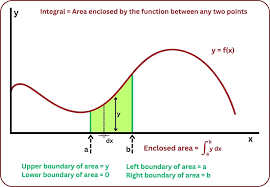
What is an integral? What is an antiderivative?
While integrals are a complex topic that will be explored in later calculus courses, they are still important to grasp at your current stage. An integral is defined as the area under a function. This won't be too useful to you right now, as you'll be learning antiderivatives. Antiderivatives are pretty similar to derivatives, but in reverse. For example, the antiderivative of 2x would be x^2. We find this by applying the power rule in reverse, adding one to the exponent and dividing the coefficient by that number. However, we missed a crucial part of that antiderivative. In most integrals, you will need to add "+C". This is to account for the fact that the derivative itself cannot show constants, so a constant is added to the integral as a variable.
Eventually, you will be asked to bridge the gap between an integral and an antiderivative. This is known as "The Fundamental Theorem of Calculus", which states that you can find the integral of a function by subtracting two antiderivatives of the same function. After all of this, you are probably asking why integrals are necessary. An integral will allow you to see the full ammassed amount of a quantity given to you by a graph, factoring in things like rate of change. So, given a graph based on a non-constant speed, you would be able to integrate that function to find your distance that you travelled.